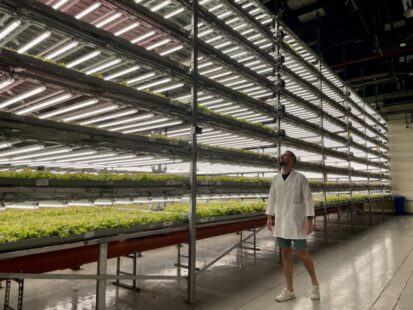
When fully operational in the second part of 2022, Eden Towers plans to produce 120 tonnes of lettuce, spinach, kale, and basil every year. The farm will use 98 percent less water and produce up to 15 times the yield of a greenhouse or open field, according to the business. In order to produce the equal output in a typical field, 6000m2 of space would be required. Moreover, by 2024, the project expects to be completely carbon neutral. Eden Towers intends to expand its business to include Adelaide, Sydney, and Melbourne, as well as Singapore and Jakarta. The sustainable farming company has reinforced its war chest by getting a financing facility as it moves forward with discussions for a Series-A round, following a successful seed capital raise in 2021.
The Perth farm, according to Eden Towers co-founder Christian Prokscha, is being funded with a mix of debt and equity, including a $650,000 seed round through the Birchal platform in June. Mr Prokscha added, “We are currently finalising the design of a four-tower industrial scale farm in Perth that will be placed at the Western Australian Food Innovation Precinct at Peel.” “We are now in talks with a number of different partners with the goal of getting up to $10 million in Series-A funding to fuel our ongoing expansion,” says the company.
The method of growing food on vertically inclined surfaces is known as vertical farming. Instead of planting crops and other things on a single level, such as in a field or a greenhouse, this approach grows them in vertically stacked layers, which are typically integrated into other structures like as skyscrapers, shipping containers, or converted warehouses. This current concept incorporates indoor farming techniques and Controlled Environment Agriculture (CEA) technology. Indoor food and pharmaceutical production is possible thanks to artificial temperature, light, humidity, and gas management. Vertical farming resembles greenhouses in many respects, where metal reflectors and artificial lighting supplement natural sunlight. Vertical farming’s main purpose is to maximise crop output in a small space.
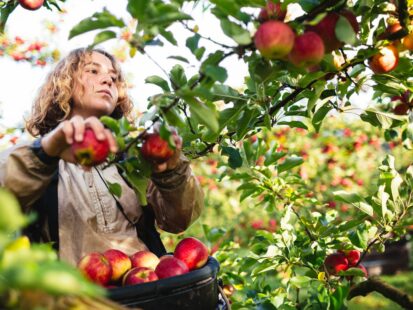
When one imagines a farmer in australia or an agricultural corporate leader, chances are that the picture is that of a man. This is because the majority of people around boardroom table in agriculture are still men, as is the typical stereotype of a farmer. This makes sense as up until 1994, where women were […]
Read More →
WHEAT: THE SUPER GRAIN OF AUSTRALIA When it comes to harvesting grains, wheat is a major winter crop grown in Australia. The sowing commences in autumn and the harvesting is based on the climatic conditions of the season. According to a general rule of thumb, wheat is harvested during spring and summer. Some of the […]
Read More →
It cannot be denied that Australia is one of the world’s largest exporters. Therefore, the nation is now set to witness a second-consecutive year of strong wheat exports. Even though there are government interventions and production cuts, Australia has still managed to sustain its exports. At the current moment, the country is forecasted to produce […]
Read More →