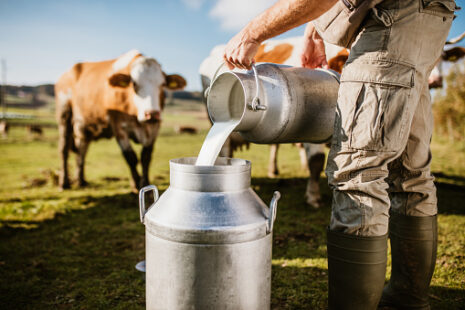
According to Rabobank’s Australian Dairy Industry: At an Important Junction report, having reached record-breaking profitability after a “rollercoaster ride” for the past decade, the Australian dairy industry is at “a critical juncture.” It claims that Australia’s dairy industry has made a spectacular comeback, owing to favourable seasonal conditions, high farmgate pricing, and a shift in the supply chain’s power balance due to increased competition for milk supply and the implementation of the Dairy Industry Code of Conduct.
Despite the promising developments, the research states that a reboot is required to achieve much-needed milk production growth. It claims that such a move is “critical” for Australia’s dairy industry’s future performance in order to capitalise on export market growth potential. Rabobank senior dairy analyst Michael Harvey, who wrote the report, said the Australian dairy industry had faced a “perfect storm” of widespread drought, isolated bushfires, and floods in recent years, all of which had been compounded by a severe global market and unprecedented industry disruption and instability. “This volatility squeezed the profit pool and reduced the amount of milk solids produced,” Harvey added. “It also shattered farmer faith, signalling a dramatic shift in the supply chain’s operation.” While national milk production is recovering, Harvey says the milk supply reaction has been “underwhelming” so far.
“The Australian dairy supply chain processed 8.86 billion litres of milk in 2020/21, 950 million litres less than in 2014/15, with the northern Victoria irrigation system accounting for 55% of the drop,” Harvey said, adding that expanding Australia’s milk supply is critical to the industry’s growth as it seeks to build sustained growth outside of a maturing domestic market. “A thriving company necessitates a strong presence in emerging export markets as well as the ability to fully use current connections to Asian supply chains,” Harvey continued. “Australian dairy has good worldwide market credentials, but a lack of a continuously rising milk pool is a shortcoming that must be overcome.”
Even in the mature domestic market, major customer demand is outpacing supply expansion, and many industry clients will want higher volume in the coming decade. According to the report, with a shortfall of milk solids in the Australian dairy supply chain and the foundations in place for a time of investment, the stage is set for the industry to capitalise. “It will be a missed opportunity for the industry to reignite growth if this strong run of healthy farm profitability, raised investment ambition, and good investment outlook does not result in some well-executed long-term investments,” Harvey added. “And, in order to fully unleash growth, major long-term capital investment in efficiency and manufacturing capacity is required.”
According to the analysis, during the next decade, Australia’s dairy sector will present attractive capital investment possibilities for farm enterprises. As a result, it emphasised that investing for long-term growth is not appropriate for every dairy farm. “While a rising industry is important for the overall sector, farm firms should only invest in growth if any planned investment strategy provides a profitable and sufficient retu

HIGH TECHNOLOGY OPPORTUNITIES IN URBAN AUSTRALIA High-tech horticulture is being used in metropolitan locations around the world for a variety of reasons, including economic development. Community involvement and environmental advantages are two things that come to mind when thinking about this project. Vertical farm systems, container farms, and other similar systems are now being witnessed […]
Read More →
The opportunity to work on a citrus farm is truly one of a kind. Moreover, working on a farm in Australia enables one to view the country through a different lens. In fact, it is a great way to meet people of different backgrounds. Usually, the main harvest commences in March and continues all through […]
Read More →
Mattina Fresh, an Australian fresh produce company, has begun pear packaging after transitioning from the summer stone fruit season to the winter pome fruit season. Tom Panna, National Sales Director, explains that he has noticed an increase in demand for pears in recent years, and that one of the reasons for this is having a […]
Read More →